
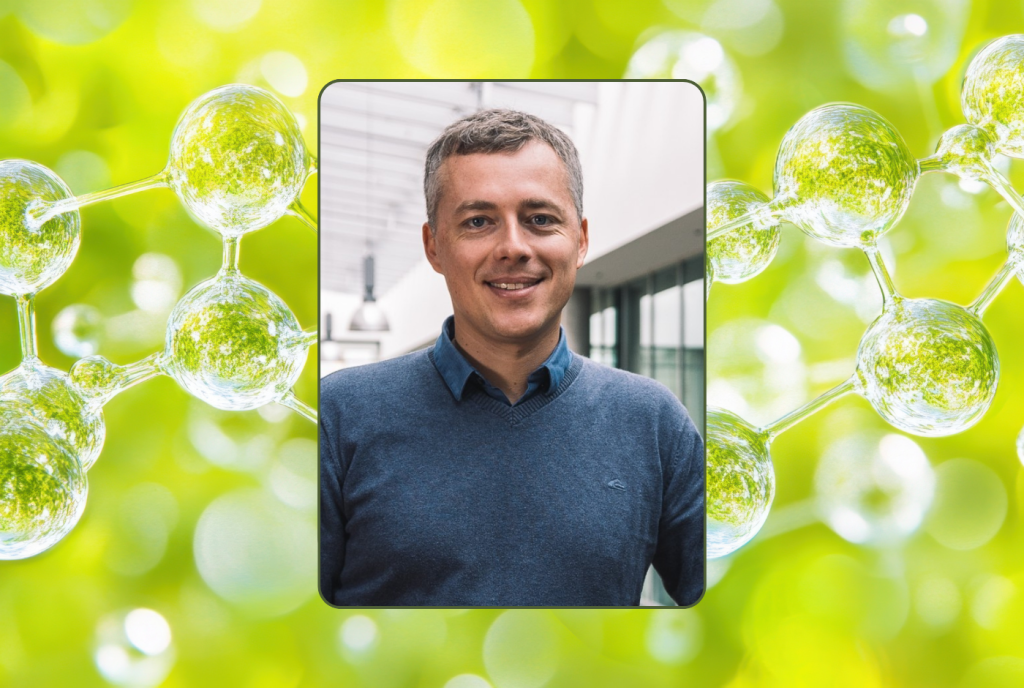
Piotr Oleskowicz-Popiel is a Full Professor at Poznań University of Technology, where he also leads the BioRef Research Group and directs the Institute of Environmental Engineering and Building Installations. With a background in chemical engineering and biotechnology, Piotr has spent much of his career exploring bio-based solutions internationally, from biogas to fermentation technologies. In this interview, he reflects on his journey into the bioeconomy, the role of his group within Rural BioReFarmeries, and why now is the right moment to advance green biorefineries.
Hi Piotr! You have a background in chemical engineering and biotechnology. What first drew you to these fields?
I always knew I wanted to be a chemist. As a kid, I even used to make homemade fireworks (I don’t know why my parents allowed it!), so I would say chemistry was my thing from an early age. I studied chemical technology in Poznań, and later moved to Aalborg University in Denmark through a scholarship to do a Master in Engineering.
At that point, I had imagined myself going into pharma or oil and gas, but in Denmark I discovered the “bio world.” I was introduced to biogas and environmental biotechnology, and it completely changed my perspective. That’s when I shifted my focus from traditional chemical engineering to the bio-based economy, and I’ve stayed in that field ever since.
After finishing my PhD at Technical University of Denmark, I travelled around to carry on expanding my knowledge on biochemistry and biotechnology. I did a postdoc at the Joint BioEnergy Institute in California, and then spent several months at the Institute of Process Engineering in China and at the Manchester Institute of Biotechnology in England.
So you’ve lived and worked in Poland, Denmark, the US, the UK, and even in China. How have these international experiences shaped your work?
Yes, I’ve been around quite a bit! I believe scientists need to travel and stay a bit longer in different places, because every country has a unique approach and different technologies. Denmark was where I first learned about biogas and lignocellulosic biomass. In the US, I saw how large-scale biorefineries could supply fuels — a more industrial perspective compared to small farm-based systems.
China showed me the importance of applied science, moving quickly from basic research to real applications. And in the UK, I explored biocatalysis, which opened new ideas about enzymatic processes. All these experiences come together and continue to inspire my work to this day.
You’ve come full circle and are back in Poznań. Can you tell us more about your current roles?
Returning to Poznań was always my dream. It has given me the opportunity to start my own research group from scratch — at first, there wasn’t even a lab! — and over time we’ve built the facilities, grown the team and started getting involved in more and more European projects.
Now, I juggle several roles. I’m a full professor, I lead the Bioref research group, and I also direct the Institute of Environmental Engineering and Building Installations at Poznan. The administrative work is a challenge, but I also see it as an opportunity to shape the direction of the Institute and inspire others.
Your group is now involved in the Rural BioReFarmeries project. What are you going to be working on?
We bring along our expertise in fermentation technologies, particularly the production of medium-chain carboxylic acids through open culture fermentation. These acids are “platform chemicals”, building blocks that can be transformed into many useful products, from feed supplements to chemicals for the fragrance industry.
In Rural BioReFarmeries specifically, we’re working with side streams from green biorefineries, which are materials that would be considered waste, but by using fermentation processes we can convert them into valuable products.
Our group also brings expertise in techno-economic analysis, which helps us evaluate whether these processes can be viable at larger scales.
So, through fermentation, you can turn waste into something valuable?
Yes! It’s all about the valorisation of sidestreams. It means taking something of little or no value — for example, a liquid byproduct from grass refining — and using microbes to transform it into something valuable.
In our case, we run long-term fermentation processes with mixed microbial cultures. Under the right conditions, these microbes convert the waste into carboxylic acids. We then extract and purify them, opening up pathways to produce a wide variety of everyday products. In short: we turn “leftovers” into resources.
You’ve been part of many EU-funded initiatives. What motivated you to join Rural BioReFarmeries?
The consortium itself was very appealing — diverse and full of expertise. I was also attracted by the idea of using grass, a resource not often associated with high-value products, and by the opportunity to combine our knowledge with demonstration plants that are already operating.
The project allows us to add real value to existing work, and to test our processes in a practical, collaborative setting.
As a biotechnologist, why do you think now is the right time to be advancing green biorefineries?
Several reasons. First, the science and technology are mature enough to move from the lab to real-world conditions. Second, the urgency is clear — we are still dependent on fossil-based products, and we must change that to reduce CO₂ emissions and tackle climate change.
Local production is also key. By producing bioproducts from local resources, we build resilience, reduce dependence on imports, and strengthen rural communities. The timing is right: the knowledge and the technologies are there, and policymakers are starting to understand the importance.
What do you hope to achieve through your involvement in the project?
Our goal is to scale up our fermentation process. We’ve already run it successfully in the lab, and the next steps are the pilot scale in Poznań and then at the demonstration site at Aarhus University.
If we can show that the process works at a larger scale, it would be a great achievement. It would prove that these technologies are closer to real implementation than many people think — and that’s very exciting.
Stay up-to date with the Rural BioReFarmeries journey!
- Follow us on LinkedIn, X and BlueSky
- Watch our latest videos on YouTube
- Subscribe to the RBRF newsletter