
As Project Manager and Marketing Manager at AUSTRALO, Giulia Pastor and Alexandra Rodriguez are the brains behind all the external communication activities for Rural BioReFarmeries.
With backgrounds spanning political science, international relations, journalism and corporate communications, they both play a key role in translating complex scientific research into accessible and engaging content for a wide range of audiences.
In this conversation, they reflect on their career paths, the evolving role of science communication in European projects, and the importance of making research visible, relevant and impactful for society.
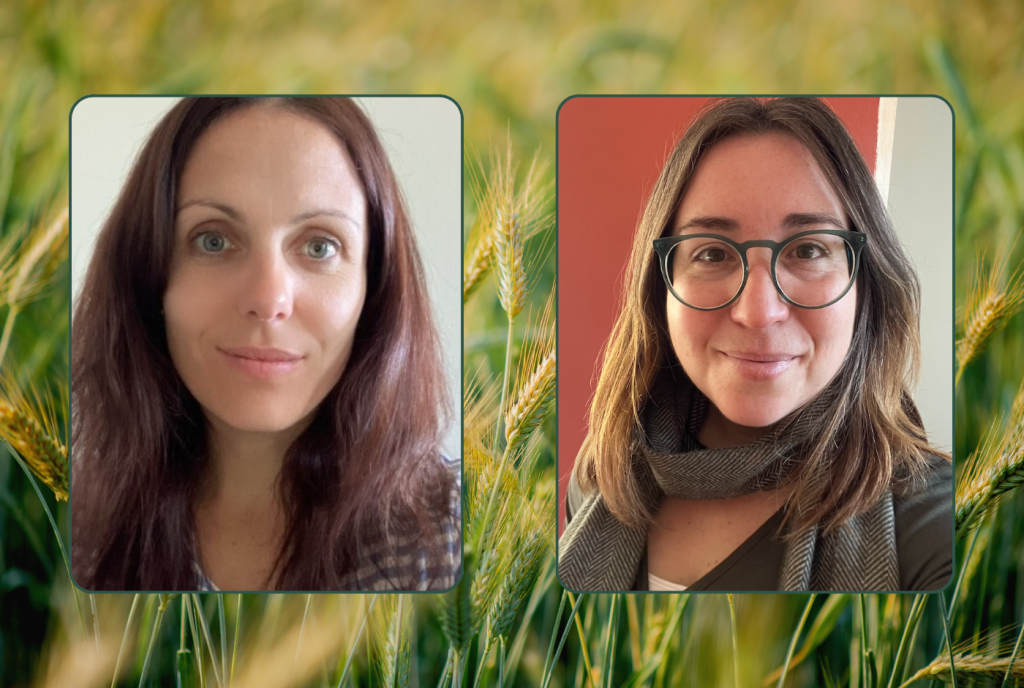
Hi Giulia and Alex! Can you tell us about your academic and professional journeys, and how you became involved in science communication?
Giulia: I have a mixed background in political sciences, international relations and European affairs. After completing my BA and two MAs in Italy and France, I started working on EU-funded projects, initially focusing on administrative and financial management.
Over time, I transitioned into communication and dissemination, and that’s where I realised I liked working closely with researchers and helping them translate complex scientific work into something more accessible and engaging.
Scientists are experts in their fields, but often need support in communicating their results to broader audiences. That’s where we, as science communication experts, come in — making sure that research doesn’t stay within academic circles, but reaches society as a whole.
Alex: In my case, it was during my degree that I decided to specialise in scientific journalism. Similarly to Giulia, I loved the challenge of helping researchers tell the story behind their innovations, and learning how to use different multimedia formats as a bridge between the lab and the general public.
I later pursued a masters in public relations, and I took a bit of a turn and started working at a creative arts university in London as an external communications specialist. That’s where I got introduced to the fascinating world of Horizon Europe, working on EU-funded research and innovation projects at the intersection of arts and science.
What really stood out to me was the sheer volume and diversity of research happening across Europe — and how little of it was visible to the general public. That’s what drew me back into science communication. I saw it as an opportunity to bridge that gap and help bring these projects to life for non-academic audiences.
How have your experiences shaped the way you approach your work today?
Giulia: Working and studying in different countries taught me how to adapt to new environments, different topics and diverse cultures and people. I believe that’s essential in our field because we work across a wide range of disciplines, from health to digital technologies to the bioeconomy, so we must be able to adapt quickly in order to best serve each project we’re involved in.
Another key aspect in my current role as Project Manager is organisation; managing communication activities across multiple projects, partners and audiences requires a structured approach. At the same time, curiosity is also fundamental — you need to be genuinely interested in learning about new topics and asking the right questions, especially when trying to translate complex science into something approachable and understandable.
Alex: I fully agree, adaptability and curiosity are also central to my role. One day I might be working on a healthcare project, the next on bio-based innovations or agriculture… I feel like I’m constantly learning, and having been trained as a journalist definitely helps in how I approach my tasks as a Marketing Manager; I actually think of myself as a reporter in each project I work for, covering all the latest news!
For me, one of the most rewarding parts of the job is being able to explain complex topics to people outside the field — whether that’s friends, family or broader audiences. If you can make someone understand and find a scientific concept interesting, then you know you’ve done your job well.
You both now work at AUSTRALO, the dissemination and communication partner for the Rural BioReFarmeries project. What does this entail?
Giulia: At AUSTRALO, we specialise in science communication, and in this project we lead the communication and dissemination activities under Work Package 7. This includes promoting the project to a wide range of stakeholders, as well as ensuring that scientific results are shared effectively following open science principles.
As I mentioned, our work is built around two main pillars: communication and dissemination. Communication focuses on raising awareness about the project, its objectives and its progress; dissemination, on the other hand, is about sharing scientific results with targeted audiences, including researchers and policymakers.
A big part of our work also involves engaging with different audiences — from scientists and policymakers to rural communities and farmers. Each group requires a different communication approach, which makes our jobs both challenging and interesting.
Alex: On a day-to-day basis, our work involves managing and running the project website and the dedicated social media channels, as well as planning and executing specific campaigns and creating a wide variety of multimedia content. We also work closely with our Brand & Design team, led by Dario Martinelli, to develop a full suite of physical and digital branded assets for the project.
During the first year of Rural BioReFarmeries, for instance, we focused on introducing the consortium and explaining the project’s goals, to start raising awareness about what the partners involved are working towards. Moving forward, we’ll increasingly put the spotlight on the first scientific results and the overall technical processes involved in transforming grass into bio-based products.
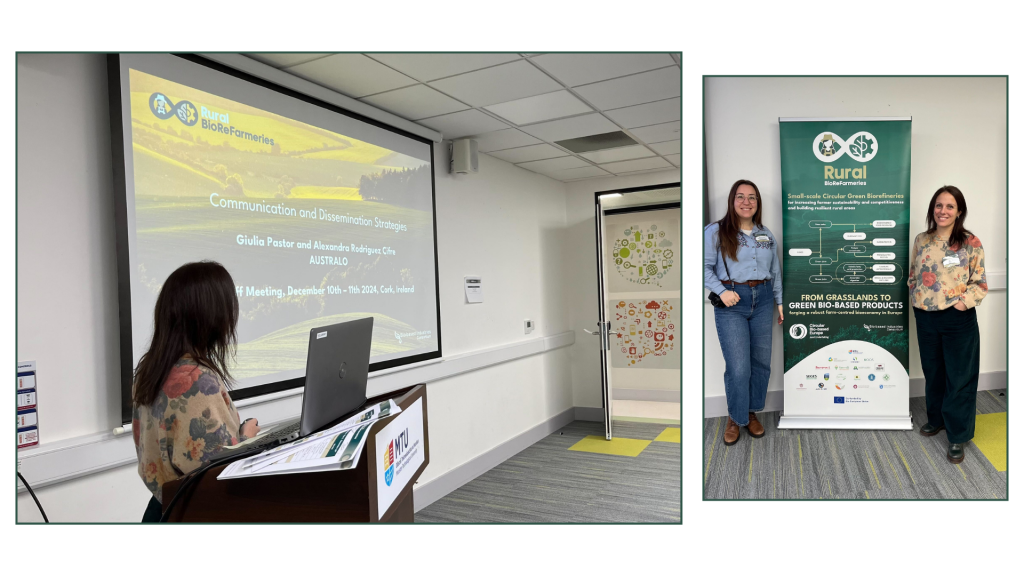
From a communications perspective, is there anything particularly unique or challenging about this project?
Alex: One of the biggest challenges is reaching audiences like farmers and rural communities, which are not always part of the traditional science communication landscape. It requires us to think differently about how we communicate and which channels we use.
At the same time, this project is very tangible, which I love! Being able to visit the demonstration sites and see the biorefinery process in action — from grass harvesting to processing — really brings the project to life. It makes it easier to communicate because you can actually see and understand the process.
Giulia: I totally agree. In many research projects, the results are highly technical and difficult to visualise, but in Rural BioReFarmeries you can actually see and even touch the outcomes.
At the same time, there is a lot of work happening behind the scenes. Communication is not just about what people see — the website, the videos or the social media posts. It also involves strategic planning, aligning with project objectives, and ensuring compliance with European Commission requirements as well as meeting the expectations set by the Circular Bio-based Europe Joint Undertaking (CBE JU).
Working in this project feels like a great balance of creativity and structure, which makes our jobs very rewarding, but also it means that every day is different.
Has anything in the project particularly surprised you or stood out so far?
Giulia: For me, it’s the transformation of grass into different products. It’s something I wasn’t aware of before, and seeing it in practice when we visited the Danish demo site facilities in AU Viborg, at Aarhus University, was fascinating.
Alex: Same! It’s incredible to see how versatile grass can be — who knew it could be used to create so many things, from packaging materials to animal feed and even high-protein plant-based foods. It really changes how you think about natural resources and their potential.
Finally, what do you hope to achieve through your involvement in Rural BioReFarmeries?
Giulia: For me, it comes down to one key idea: science for society. Research should be accessible and understandable to everyone. It’s important that people are aware of how scientific work — and public investment in research — contributes to society.
If people better understand what is being done and why it matters, it can also influence how research is valued and supported in the future; and not just in Europe, but worldwide.
Alex: From my perspective, I would like to show that science communication can create meaningful engagement, not just more noise. We live in a world where people are constantly exposed huge volumes of information, so the challenge here is to create content that truly connects with our target audiences. If we can build engaged communities and communicate the value of the project in a clear and meaningful way, then we’ve achieved our goal.