
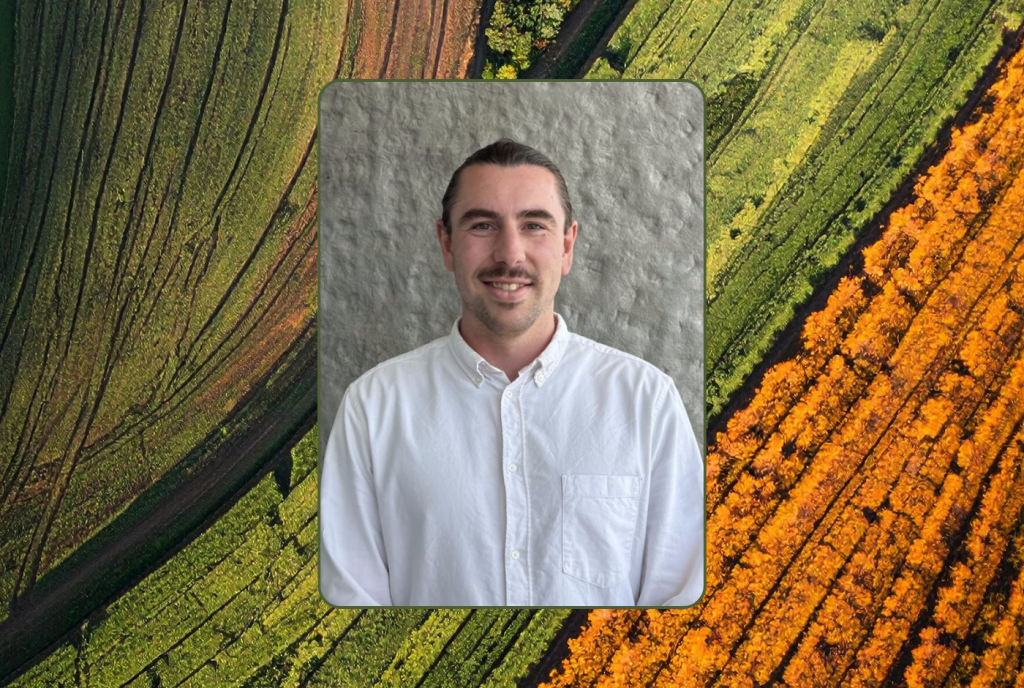
Cian White is the director and co-founder of ODOS. With a background in zoology and ecological research, Cian’s work has been mostly focused on the intersection between people, agriculture and nature. As a partner in Rural BioReFarmeries, he and his team at ODOS are bringing their expertise in carbon accounting and biodiversity analysis, helping to assess the environmental impacts of the green biorefinery model compared with conventional agricultural systems.
We spoke with Cian about his academic journey, the origins of ODOS, and how data can help farmers, companies and policymakers better understand the environmental footprint of agricultural production.
Hi Cian! You studied zoology at university. What led you to choose that path?
Interestingly, zoology wasn’t my original plan. I started out in a general science programme and I thought I would end up going into genetics or chemistry, but during that time I became more and more interested in topics around evolution and ecology — the big questions about how species evolve, how ecosystems function and how behaviours emerge were much more engaging to me than the highly detailed molecular side of biology. So I chose to specialise with a degree in Zoology at Trinity College Dublin.
After your degree you continued into a PhD. What made you stay in academia rather than moving into industry?
During my time at university I was involved in organising events through the Zoological Society, and that’s how I first connected with the professor who later became my PhD supervisor. She had been invited to give a talk on insects and pollinators at one of our events, and she mentioned that a PhD opportunity studying pollinators had opened up; since I didn’t have a clear plan at the time, I decided to go for it!
What kinds of research questions were you focusing on during that time?
The main theme of my research has always been the relationship between people and nature, particularly how both can coexist in the same landscapes.
During my PhD I studied plant–pollinator communities in agricultural and urban landscapes. The central question was how we can conserve biodiversity in areas that are already heavily used by people — farms, cities or managed forests — rather than relying solely on protected areas like national parks.
Over time, the conservation field has shifted from focusing only on pristine natural areas toward integrating conservation into working landscapes. That means engaging directly with farmers, land managers and communities to identify solutions that protect biodiversity without undermining livelihoods. That perspective has shaped how I approach sustainability today.
You then started your own company, ODOS. What sparked that decision?
ODOS is essentially a sustainability data analytics company focused on agriculture. We work mainly with food processors and agricultural supply chains to understand their environmental impact, particularly their carbon footprint and biodiversity impacts.
The idea for the company came from a research project in Ireland that I was involved in, working as a post-doc researcher at Farm Zero C, where we were looking at how the Irish dairy sector could remain economically viable while also reducing emissions and protecting biodiversity. I met my co-founder Alejandro Vergara there; he was responsible for analysing the carbon footprint of a dairy farm, while I was analysing biodiversity on the same farm.
Through that work, we realised there was a clear demand from companies to measure sustainability across their entire supply chains. We decided to spin the research out into a company and started building tools that could analyse emissions and biodiversity across thousands of farms, efficiently and cost-effectively.
What does ODOS do for agricultural supply chains?
Typically, companies come to us with a simple question: how sustainable is our supply chain?
Most of the time that starts with carbon. Companies want to know how much greenhouse gas emissions are associated with their products and how those emissions could be reduced. So we analyse supply chains — sometimes involving thousands of farms — and calculate emissions at farm and product level.
Alongside that, we also map biodiversity impacts using a combination of farm data and satellite imagery. This allows us to identify where improvements could be made and what actions might deliver the greatest environmental benefits.
The next step is helping companies design strategies to reduce their footprint. That might involve adopting new farming practices, introducing incentives for farmers or implementing new technologies.
When it comes to sustainability, what motivates farmers to engage with new technologies or innovative approaches?
It’s important to understand where farmers are coming from. Farming is a business, and for most farmers the priority is maintaining a viable livelihood. If a sustainability measure threatens that, it’s unlikely to gain traction.
At the same time, many farmers do care about the long-term condition of their land. Passing a productive and healthy farm on to the next generation is a strong motivator. Increasingly, there is also recognition that biodiversity and soil health can contribute to long-term productivity.
One approach that is becoming more common is “insetting”. Instead of companies buying carbon offsets elsewhere, they invest in reducing emissions within their own supply chains. For example, a food company might pay farmers a premium if they adopt practices that lower emissions or improve biodiversity.
What we are developing at ODOS is essentially the infrastructure to support those programmes — measuring impacts, verifying reductions and helping companies design incentives that work for farmers.
ODOS is a partner in the Rural BioReFarmeries project. What are you going to be working on?
Within the project, our role is primarily to quantify the environmental impacts of the green biorefinery model.
We will compare the emissions and biodiversity outcomes of conventional agricultural systems with those of the biorefinery approach. For example, one key comparison is between importing soybean protein for animal feed and producing protein locally through grass-based biorefining.
From a carbon perspective, we will calculate the emissions associated with different configurations of the biorefinery process. This includes analysing the potential emission reductions and the economic costs associated with different scenarios.
From a biodiversity perspective, we will assess how changes in land use — such as growing grass for biorefining rather than relying on imported feed — could affect habitats and species.
Ultimately, the goal is to provide robust data that can help determine whether the biorefinery model offers real sustainability benefits at scale.
What is it about this EU-funded initiative that made you want to be involved?
For us, it’s about staying connected to emerging technologies that could reshape agricultural systems.
Feed production is a major contributor to the carbon footprint of livestock farming. If technologies like green biorefineries can significantly reduce those emissions — while still producing economically viable products — that could be very important for the future of the sector.
By participating in the project, we can evaluate these technologies early and understand their potential impact. If they prove effective, we can help bring that knowledge to the companies and supply chains we work with.
Looking ahead, what would you most like to see achieved by the end of the project?
For me, the key question is practicality. It’s one thing to develop innovative technologies, but the real challenge is whether they can work in the real world. Can the system be economically viable for farmers and processors? Can it scale beyond a demonstration project?
Ideally, by the end of the project we will have demonstrated that the green biorefinery model reduces emissions and that it can also make economic sense. If the technology creates valuable products and provides a clear business case, then it has a much greater chance of being adopted widely.
That’s ultimately what I’m most interested in — whether this can become a viable industry in the coming years.