
Joep Smits is the Research & Technology Manager at PaperFoam, a Dutch company with global operations specialised in the development of sustainable and bio-based packaging solutions.
Following an academic background in biology and years of experience in project management and managing innovation activities, Joep now leads PaperFoam’s research department, helping bridge scientific discoveries with practical applications. In the Rural BioReFarmeries project, PaperFoam is working alongside Wageningen University & Research to explore how grass fibres recovered from green biorefineries can be incorporated into sustainable packaging materials.
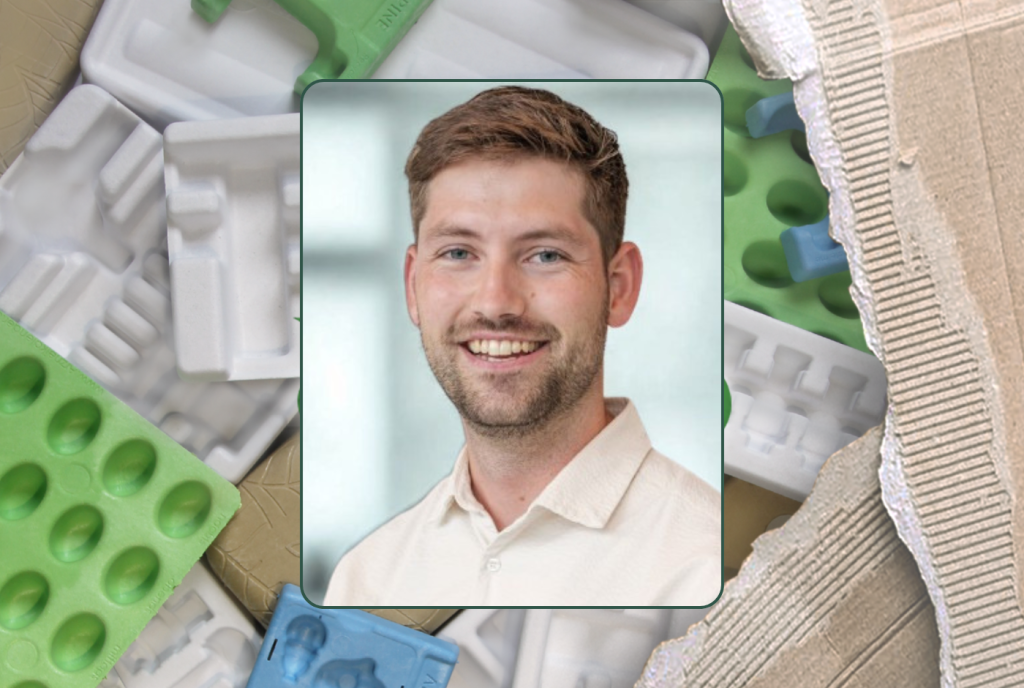
Hi Joep! Tell us about how your academic journey led you to the work you’re doing today.
I completed both my Bachelor’s and Master’s degrees in Biology at Wageningen University & Research in the Netherlands, specialising in biochemistry and molecular and cellular biology. During my studies, I became fascinated by how proteins and other biomolecules interact to shape life.
After graduating, I joined PaperFoam through a graduate internship programme that introduced me to the company’s different departments. I stayed on as a Project Manager, where I enjoyed helping translate new technologies into products that could be manufactured at scale.
After four years, I decided to explore a new opportunity elsewhere. But last year PaperFoam invited me back as Research Manager, offering me the chance to coordinate the research team, connect different departments and oversee innovation from a broader perspective. It felt like the perfect opportunity to return.
Did you always picture yourself working in packaging?
Not at all! Packaging wasn’t something I had planned to work in.
During my studies I travelled quite a bit, including to Central America and Asia, and what really struck me was the amount of plastic pollution I saw — on beaches, in rivers and in the ocean. It was something that stayed with me, and I realised I wanted my work to contribute, in some way, to solving that problem.
What attracted me to PaperFoam initially was the opportunity to develop biodegradable packaging that could replace plastic. Of course, changing people’s behaviour is important, but I also think we need better alternatives. If we can replace plastic packaging with materials that are biodegradable and bio-based, we can make a real difference.
My dream is that one day people can walk along a beach and simply enjoy the view, instead of seeing plastic washed up everywhere.
So, what exactly is PaperFoam? And what makes it different from other packaging companies?
Well, the answer is actually in the name!
We use the same basic ingredients as paper, mainly starch and fibres, but in different proportions. Traditional paper contains a lot of fibres and relatively little starch, whereas our material contains mostly starch and a smaller amount of fibres.
The “foam” part comes from our manufacturing process. We mix starch, fibres, water and our own proprietary ingredient before injecting the mixture into a heated mould at around 200°C. As the water heats up, it turns into steam, which naturally expands and pushes the material into every part of the mould. In other words, the water acts as the foaming agent.
The product is essentially “cooked” inside the mould until all the water has evaporated, leaving behind a lightweight, biodegradable packaging material.
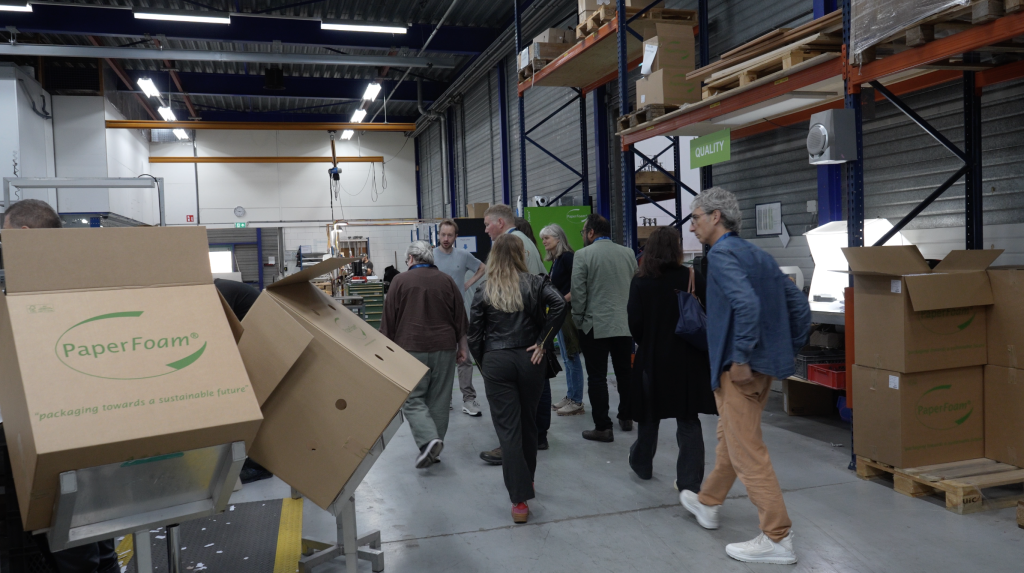
As you mentioned, plastic packaging pollution has become a real issue in today’s world. How can a company like PaperFoam help to tackle this challenge?
One of the things I admire most about PaperFoam is that we’ve shown it’s possible to take an idea for sustainable packaging and make it commercially successful.
We’ve been around for almost 30 years, and we’ve demonstrated that bio-based packaging can be produced at industrial scale. For many consumer products, we’ve shown that sustainable packaging can compete not only environmentally, but also in terms of price and design.
Sometimes people are hesitant because they’re so familiar with plastic or cardboard. But once they understand that our packaging has an exceptionally low carbon footprint, and that it performs just as well, they’re often very enthusiastic.
I think it’s important to show people that choosing a more sustainable option doesn’t necessarily mean compromising on quality or functionality.
PaperFoam is one of the industry partners involved in Rural BioReFarmeries. What is your role in the project?
Our role focuses on finding valuable applications for grass fibres that remain after proteins and other high-value compounds have been extracted from grass.
At the moment, those remaining fibres often have little or no value. The idea behind Rural BioReFarmeries is to make full use of every part of the biomass so that nothing becomes waste – basically, to create a true circular approach for green biorefineries.
Currently, at PaperFoam we use wood fibres in our products. Through our involvement in this project, we’re investigating whether grass fibres could replace those wood fibres and make our packaging even more sustainable.
For this, we are working very closely with ACRRES at Wageningen University & Research throughout the process; they produce and refine different grass fibre samples that they obtain from Ireland, Denmark and The Netherlands, while we test how those fibres behave in our manufacturing process. Initially, some of the fibres were too coarse and tended to clog our equipment, but through several rounds of collaboration and feedback, the fibre quality has improved significantly. It’s a very iterative process where both partners continuously learn from each other.
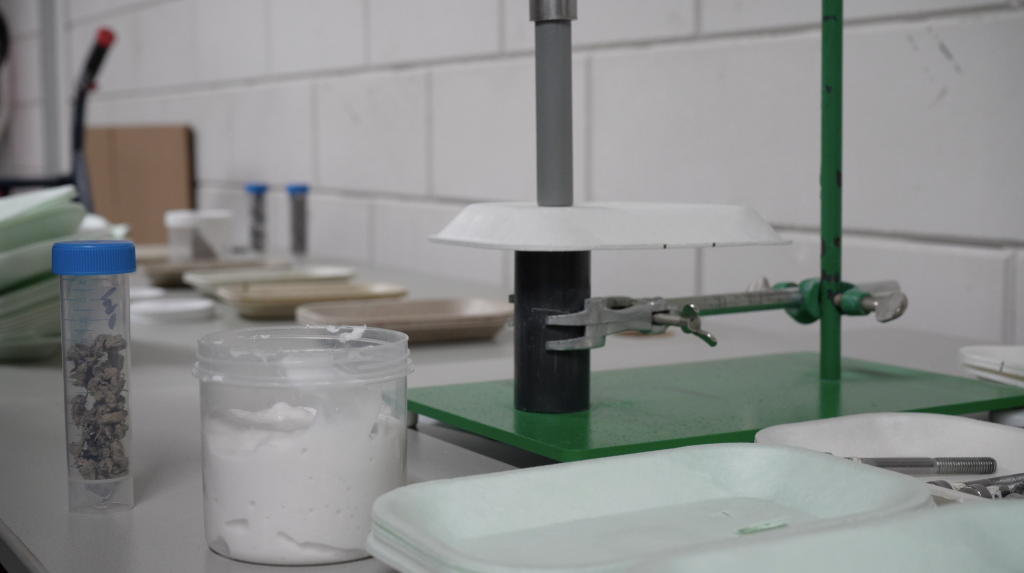
At this stage, we’re testing the new materials by producing prototype trays and evaluating properties such as colour, strength and manufacturability. We also carry out various mechanical tests, including drop tests, to compare the new material with our current products. That’s the main goal – to obtain the same strength in our products with grass fibers compared to wood fibers; together with the ACRRES team we are coming up with ideas to increase the strength of grass fibers by applying different treatments.
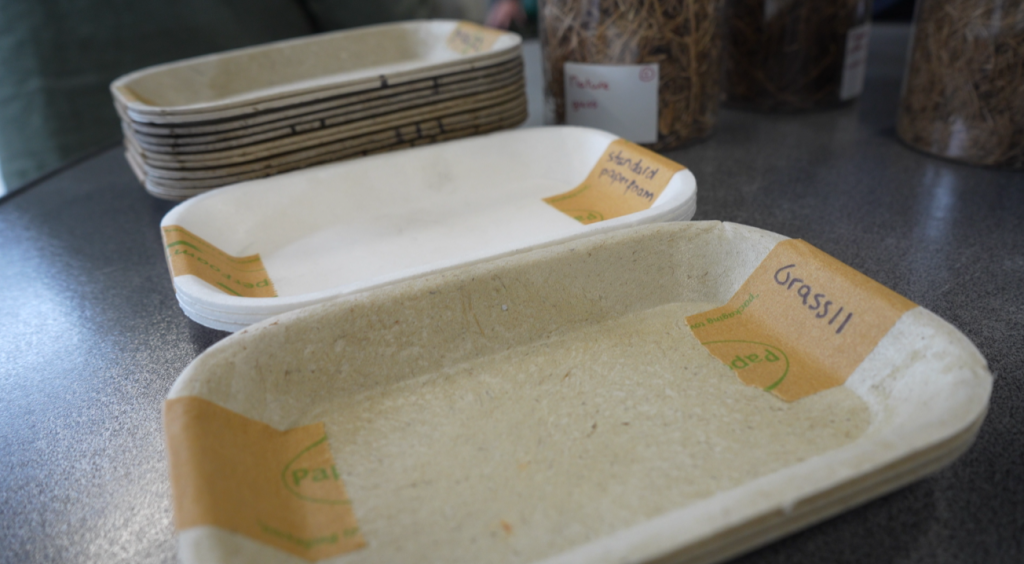
The first prototypes are small rectangular trays. Why did you choose that particular design?
Two main reasons.
The first is simply practical. We already have a testing machine equipped with that mould, which allows us to compare new fibre recipes under exactly the same conditions every time.
Secondly, the tray has a relatively flat surface, making it ideal for mechanical testing. We can repeatedly perform impact and drop tests on different areas of the tray and obtain reliable, comparable results.
Once we’re confident that the new fibre recipe performs well, it can potentially be applied to many different packaging designs.
Do you see these grass fibres being used across all of PaperFoam’s products in the future?
Potentially, yes — but it will depend on the application. Some of the products we package are extremely lightweight, such as earplugs, while others, like perfume bottles, require much stronger protective packaging.
Our current prototypes are helping us understand where grass fibres perform best. It may be that they’re suitable for every application, or perhaps only for certain types of packaging. That’s exactly what this research is helping us determine.
Why was it important for PaperFoam to become involved in Rural BioReFarmeries?
In a few words – because we always strive to make our products as sustainable as possible.
Although the wood fibres we currently use are responsibly sourced, they’re still grown specifically for industrial use. If we can instead use fibres that would otherwise become waste, we can reduce the environmental impact even further.
That’s why collaborating with universities and research organisations is so valuable for us. They bring expertise that complements our own, and they often look at problems from a completely different perspective.
Sometimes, when you’ve been working on the same technology for many years, it’s easy to become stuck in certain ways of thinking. Collaborating with external partners brings fresh ideas and new ways of approaching challenges.
Looking ahead, what would success look like for you at the end of the project?
For me, the ideal outcome would be to establish a complete local value chain.
Imagine grass that’s harvested in the Netherlands, processed into valuable fibres by Wageningen University & Research, transformed into packaging by PaperFoam, and finally used by a Dutch company to package its products.
That would create a truly circular system, where a material that would otherwise become waste is turned into something valuable within a local production chain.
I also think it’s a powerful story. Being able to tell consumers that a package has been made using locally sourced grass fibres would demonstrate that circularity isn’t just a concept — it can become a reality.