
Ireland’s National Support Network for Horizon Europe puts the spotlight on Rural BioReFarmeries’s potential to boost rural economies and the EU’s bioeconomy.
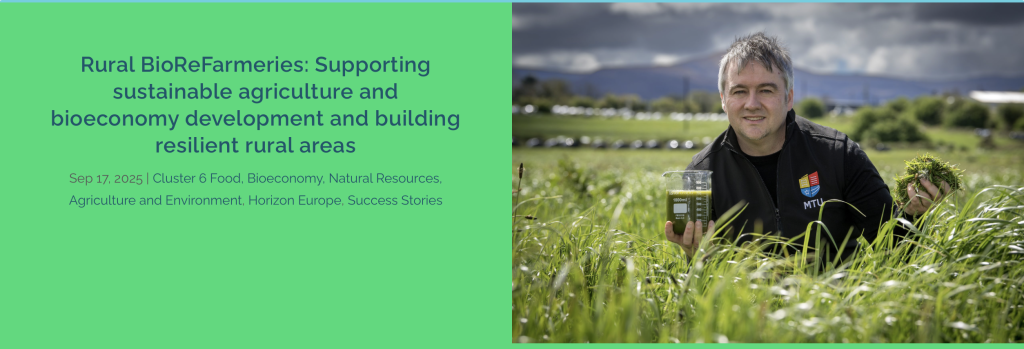
Read the full article published by Horizon Europe Ireland.
Published on 17th September 2025, the article also highlights how our Horizon Europe-funded research project will deliver significant environmental benefits by optimising Ireland’s most abundant natural resource, grassland. It also delves into how the consortium, led by Munster Technological University, will focus on demonstrating a small-scale, decentralised model for green biorefineries in Europe, making the case for how grass can become a sustainable alternative in the production of bio-based products — from protein ingredients for human and animal consumption, to packaging materials, fertilisers and even biogas.
James Gaffey, Project Coordinator, is quoted throughout the article reflecting on the main elements that make Rural BioReFarmeries a highly relevant and necessary project to support the EU’s ambitions in building a robust circular bioeconomy. He also speaks about the importance of involving the existing farmer co-op network in Ireland, as well as tapping into the commercial and scientific knowledge of other partners from across Europe.
“We knew that a lot of great work was happening in other countries, and we wanted to bring in new overseas partners to bring in new thinking and new possibilities. It has also allowed us to collaborate with industry partners, who can bring real world and market experience, which can help to validate the processes and products we are developing, which in turn can help us to optimise our approach and increase the opportunities for commercial uptake. Another attractive aspect of the funding is that it promotes innovation and has allowed us to build and scale new technologies and products.”
The article closes with a special mention to the work being carried at our Irish demo site, Farm Zero C, and how it will help to understand the challenges that need to be overcome in order to make the green biorefinery model successfully adopted in other European rural regions.