
Piergiuseppe Morone is Professor of Economic Policy at Unitelma Sapienza, where he leads the Bioeconomy in Transition Research Group; Eleonora Staffieri is a post-doc researcher within the same group, where she focuses on bioeconomics, sustainability and circular economy. In this interview, they share their motivations for joining the Rural BioReFarmeries project, and why placing people at the centre of green innovation is crucial for a successful transition to a just and inclusive bioeconomy.
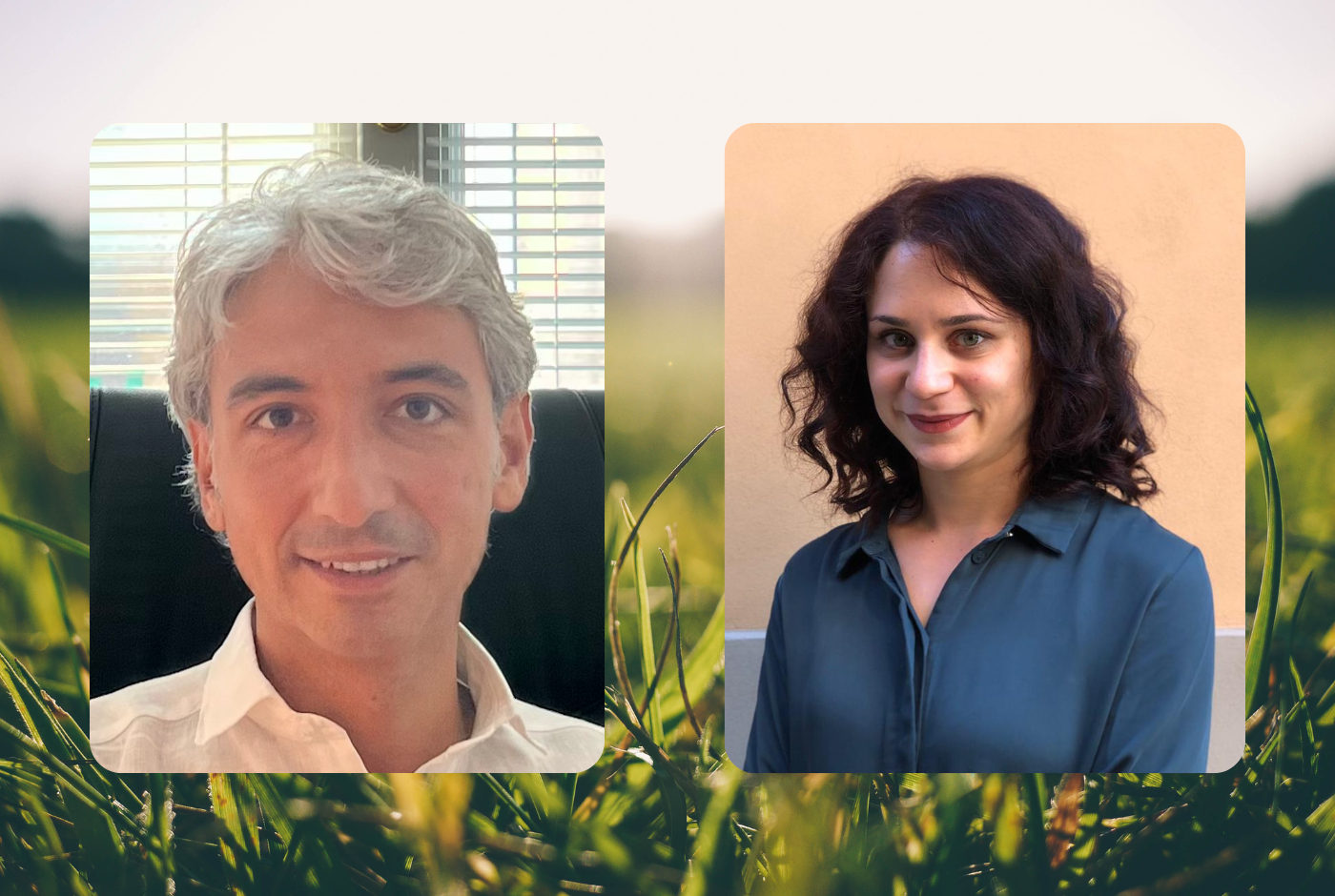
Hi Eleonora and Piergiuseppe! Can you tell us about your academic and professional backgrounds, and how you got to work together at Unitelma Sapienza?
Eleonora: I’m a researcher in the Bioeconomy in Transition Research Group at Unitelma Sapienza, coordinated by Professor Morone. I originally studied Biology, then specialised in Ecotoxicology and Environmental Sustainability. After that, I completed a professional master’s degree in Energy & Green Management, where I started focusing on the circular economy and sustainable transitions.
That experience inspired me to return to academia, and in 2021 I was awarded a PhD scholarship in Economic and Social Sciences, with a project focusing on sustainable finance and its role in promoting the bioeconomy. I’m now close to defending my thesis and have recently started a postdoctoral collaboration at Unitelma Sapienza. In this role, I currently coordinate the university’s contribution to the Rural BioReFarmeries project, while also supporting other research initiatives within the group.
Piergiuseppe: I’m a Professor of Economic Policy at Unitelma Sapienza, where I also teach economics of innovation, and about eight years ago I established the Bioeconomy Transition Research Group. We’re now a team of around 15 researchers, and we’re involved in several national and European-funded projects.
Our research focuses on the social and economic dimensions of the transition from a fossil-based linear economy to a circular, bio-based one. We work across two main areas: sustainability assessment, including life cycle assessment and social life cycle assessment; and market-related topics, such as consumer behaviour and the policy frameworks needed to support bio-based product uptake.
I’ve also recently co-authored a book titled The Circular Bioeconomy with colleagues from Finland, France, and our own group here in Rome. Beyond academia, I’ve served as advisor to the Italian Ministry for the Environment, and I currently act as Vice Chair of the Scientific Committee of the Circular Bio-based Europe Joint Undertaking. I’m also Editor-in-Chief of a relatively new journal published by Elsevier called Societal Impact, which focuses on the tangible societal value of academic research — a mission that resonates deeply with our group’s work.
Piergiuseppe, what prompted the creation of the Bioeconomy in Transition Research Group?
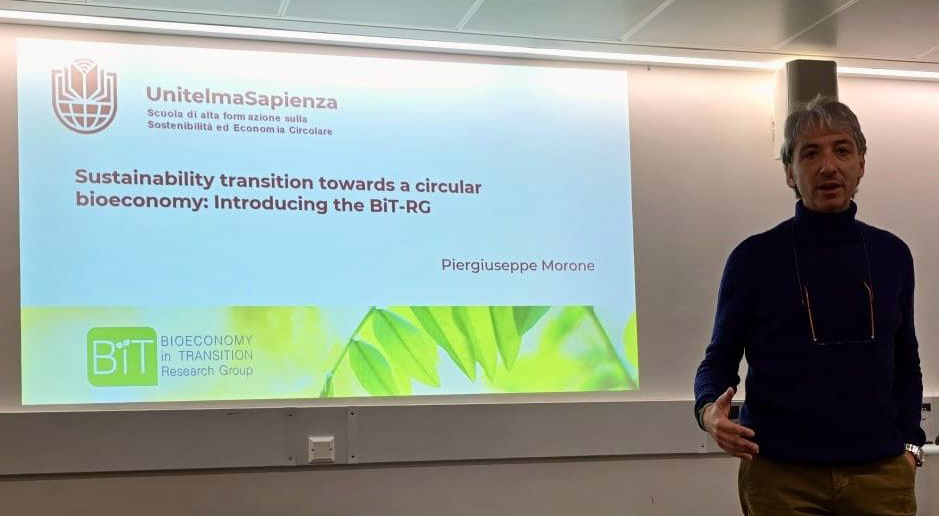
My background is in the economics of innovation, and I first came into contact with the bioeconomy in 2012 through a project on sustainable oil production, under the EU’s Seventh Framework Programme. I quickly realised that while the technical and scientific aspects of the bioeconomy were being explored, its social and economic dimensions were largely missing.
At the time, it was common to see engineers, chemists and biotechnologists in the field, but very few economists. I used to say, “The bioeconomy includes everything but economics.” So, I decided to bring that missing piece into the conversation. In 2017, we successfully started coordinating a Horizon 2020 project, which gave us the foundation to bring researchers on board and formally launch the group.
Eleonora, what motivated you to specialise in the bioeconomy?
After my master’s degree, I started working with several national institutions, including the Regional Environmental Protection Agency (ARPA) and the National Research Council (CNR), in projects focused on the remediation of contaminated areas. The aim wasn’t only environmental restoration, but also to explore opportunities for value creation from these interventions.
That was my first real exposure to the circular bioeconomy, and after that I was hooked. I found the topic so compelling that I decided it was what I wanted to dedicate my research career to.
You’re both now involved in the Rural BioReFarmeries project. What are you going to be focusing on?
Eleonora: Our team leads Work Package 6, which assesses the environmental, social and economic sustainability of the small-scale green biorefineries. It’s a crucial part of the project, as it helps determine whether the models we’re proposing are truly viable and impactful.
We’re directly responsible for two core tasks. The first is a systematic literature review of existing studies and past projects to identify best practices for assessing biorefineries. The second is a social life cycle assessment, which focuses on how these technologies impact local communities, looking at aspects such as employment, well-being and inclusion.
We’re taking a participatory approach, engaging directly with local stakeholders — farmers, authorities and community actors — to understand their experiences and perspectives. This is how we can best drive a just and impactful transition into a circular bioeconomy.
We’re also active in Work Package 7, which looks at how to make these models replicable and how to create supportive ecosystems around them. One of our key responsibilities there is leading the task on social acceptance, which involves interviews and participatory workshops to identify barriers and co-create policy recommendations grounded in local realities.
How will the project benefit from having your team’s expertise in bioeconomics?
Piergiuseppe: As economists and social scientists, we focus on aspects like social acceptance, which is fundamental to any successful transition.
Moving from a fossil-based economy to a bio-based one isn’t just about switching technologies — it’s about changing behaviours, consumption patterns, and cultural norms. That kind of transformation requires alignment among many actors and stakeholders.
This is where our role becomes central. We assess people’s expectations, understand their concerns, and work to shape pathways that are both technically sound and socially inclusive. If we don’t bring society along in this transition, the risk is that promising technologies will be resisted — or worse, fail to take root.
Eleonora also mentioned the idea of a just transition, which is especially relevant in rural areas. These are communities that could either benefit immensely or be left behind, depending on how the transition is managed. So, part of our job is making sure that we contribute to fair, inclusive solutions that empower rather than displace.
Why is now an important time to focus on implementing a circular bioeconomy across Europe?
Piergiuseppe: Honestly, the best time would have been 20 or 30 years ago… but here we are. It’s already late, but that’s no reason to give up — we need to act now, with urgency and determination.
We know there are challenges ahead, of course. The current geopolitical context risks pushing sustainability off the political agenda, but that’s precisely why we need to double down. We can’t afford to lose momentum, because the window for meaningful change is rapidly closing.
There are currently many EU-funded initiatives centered around the bioeconomy. What drew you to the Rural BioReFarmeries project specifically?
Eleonora: From the very beginning, I felt a strong connection with this project. It aligns closely with my values. It puts rural communities and farmers at the centre — not just as beneficiaries, but as key players in innovation. That’s a powerful and much-needed approach.
On a personal level, I also have roots in the farming world; my grandparents were farmers in the Italian hinterland. So for me, it’s also a way to give something back through my research.
I strongly believe in the potential of the bioeconomy to revitalize marginalized rural areas while promoting inclusive innovation, environmental sustainability and social justice.
Piergiuseppe: I share a lot of Eleonora’s views, although my grandparents weren’t farmers! What really impressed me was the way the consortium was built. It was a very professional and thoughtful process, and I truly enjoyed collaborating on the proposal from the beginning.
This project has all the ingredients to deliver real impact. I’m particularly excited to see how we can build functioning, community-rooted green biorefineries and make them part of a broader, replicable model.
We have to make sure we can integrate this technology properly in rural areas, and creating a fully functioning and supporting network of actors around our mission will be key to achieve our expected outcomes.
Interdisciplinarity is a core part of this project. What are you hoping to learn by working with other European partners over the next four years?
Piergiuseppe: Working in this field, you’re naturally exposed to interdisciplinary collaboration — but what makes this Rural BioReFarmeries special is the direct engagement with farmers. In past projects, we’ve worked with consumers, large companies, and even policymakers. But this is a unique opportunity to understand how the bioeconomy transition looks from the ground up, from the perspective of those who will be most directly affected.
Eleonora: This is actually my first direct experience with a large EU project, so I’m really excited to learn from colleagues across Europe and to test myself in this kind of collaborative setting. I also hope to reconnect with some of my earlier studies in ecotoxicology and learn more about the technical side of biorefinery processes. I’m especially interested in how other countries are approaching the ecological transition, and how they involve their local communities in shaping innovation.
Stay up-to date with the Rural BioReFarmeries journey!
- Follow us on LinkedIn, X and BlueSky
- Watch our latest videos on YouTube
- Subscribe to our newsletter