
At the end of 2025, the European Commission launched an updated version of the Bioeconomy Strategy, which has been received by many experts as a clear sign of Europe’s ambitions in becoming a leader in sustainable, regenerative and competitive growth. But what’s the expected impact of this strategy? Who will benefit from it? And is there anything to be cautious about?
In this article, Piergiuseppe Morone, Full Professor of Economic Policy at Unitelma Sapienza and Coordinator of the Bioeconomy in Transition Research Group, shares his views on the EU Bieconomy Strategy from an economic and policy perspective.
What is the EU Bioeconomy Strategy and what does it entail?
The EU Bioeconomy Strategy is a plan by the European Union to grow its economy using renewable biological resources (like plants, waste, forests, algae and microbes) instead of fossil fuels and non-renewable materials in ways that help fight climate change, protect nature and create green jobs.
It’s about using biology and biotechnology to make food, materials, chemicals, energy and other products in a circular and sustainable way rather than relying on fossil resources. In this sense, it has been rightly defined as the green heart of the circular economy.
Targeting competitiveness, resilience and independence from imported fossil resources, the strategy of the European Union aims to strengthen research, innovation and investment to help companies develop and market bio-based products.
It also aims to support jobs, particularly in rural and coastal areas, while ensuring that biological resources are used sustainably and biodiversity is protected, in line with Europe’s broader goals of climate neutrality and a low-impact circular economy.
So, in a nutshell, the Strategy aims to shift from a fossil-fuel-based industrial model to one that uses nature’s own resources responsibly, driving innovation while protecting the environment and creating jobs across many sectors.
Why is a dedicated strategy for the bioeconomy needed in Europe?
As Jessika Roswall (European Commissioner for Environment, Water Resilience and a Competitive Circular Economy) recently stated: “Europe’s bioeconomy is not a niche, it is an industrial core policy. Already today it generates 2.7 trillion euros of value, it creates 17 million jobs around Europe and it is cutting our emissions, and at the same time reduces our dependence on fossil fuels”.
From an economic perspective, a dedicated bioeconomy strategy in the European Union is needed, and arguably timely, for three main reasons.
First, given its broad spectrum of action, the bioeconomy meta-sector could incur in classical problems of coordination failures. It spans agriculture, forestry, fisheries, chemicals, energy, waste management, biotechnology and manufacturing sectors that are typically regulated and supported separately. Without a shared framework, investment signals remain fragmented, innovation systems siloed, standards inconsistent and cross-border value chains slow to develop.
A common strategy helps align research funding, industrial policy, environmental regulation and rural development, reducing uncertainty for investors and lowering overall transition costs.
Second, biobased production can reduce fossil dependence and emissions, but if poorly managed it may also increase land-use pressure and biodiversity risks. Because markets do not properly price these environmental externalities, public intervention is necessary to level the playing field – also with respect to conventional fossil-based products – and set sustainability boundaries, embed circular economy principles and ensure ecosystem protection.
Third, the bioeconomy is not limited to innovative materials such as bioplastics; it also includes valorising agricultural residues, developing bio-refineries and transforming waste streams into higher-value products. For many rural and coastal regions, this represents an opportunity for structural diversification, especially in the context of demographic decline and geopolitical supply chain disruptions.
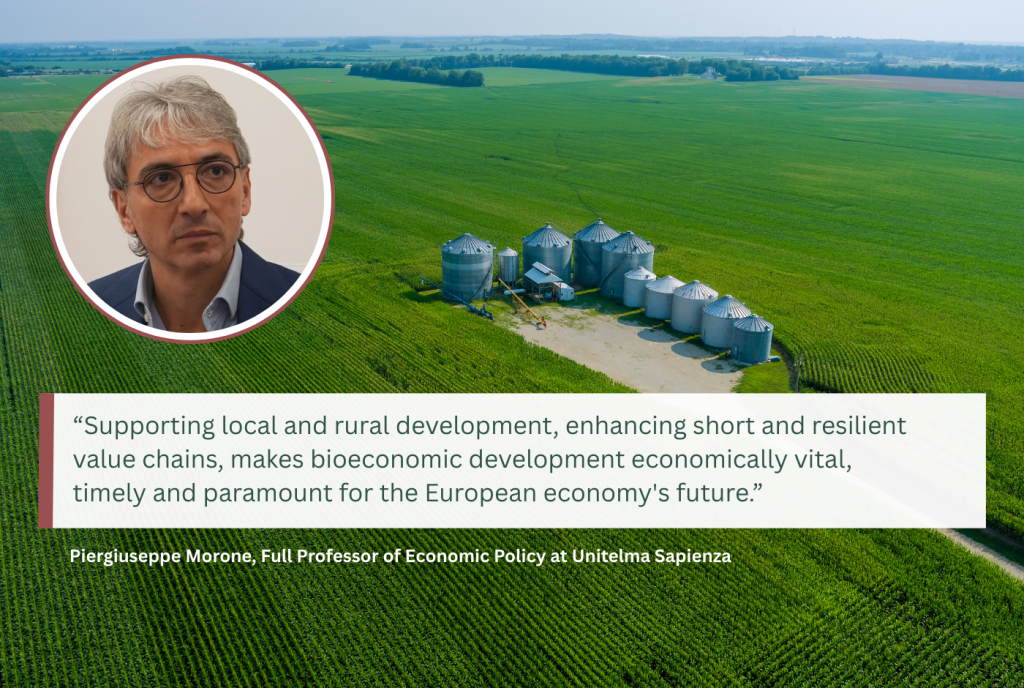
Supporting local and rural development, enhancing short and resilient value chains, makes bioeconomic development economically vital, timely and paramount for the European economy’s future.
What sectors will be positively impacted by this strategy?
The strongest positive impacts are likely in sectors where biological resources can replace fossil inputs or where waste can be transformed into higher-value products.
Agriculture and forestry may benefit from new revenue streams linked to residues and integration into bio-refinery supply chains, particularly in rural regions across the European Union.
Bio-based manufacturing and chemicals including bioplastics, advanced biomaterials and sustainable aviation fuels, will also gain from research support, regulatory clarity and demand incentives.
Biotechnology start-ups, research institutes and innovation clusters will benefit from coordinated R&D and reduced commercialisation risks, while waste management and circular economy services will benefit from the emergence of stronger markets for secondary biological resources.
Are there any areas that, in your opinion, have been overlooked?
In my view, the strategy is directionally strong but raises some concerns. Biomass is finite and already heavily used for food, feed, materials and energy; rapid expansion could intensify land-use pressures, affect food prices or shift environmental impacts abroad. A clearer prioritisation framework, for example favouring high-value uses before energy uses, would strengthen sustainability.
Overall, the strategy is economically rational and timely. However, without strong sustainability design, clear limits on resource use, and coordinated policy implementation, the strategy could face environmental, economic, and social risks as the bioeconomy scales up.
These risks are not unavoidable, but they highlight why intentional governance and safeguards are essential if the EU bioeconomy is to be both circular, sustainable and just.
Thinking about the mission of Rural BioReFarmeries, can you draw any connections between the project and the goals of the strategy?
There are several clear points of alignment between the EU Bioeconomy Strategy and the work carried out within RBRF.
A core pillar of the Bioeconomy Strategy is the transformation of agricultural, forestry and industrial residues into higher-value products, instead of allowing them to go to waste. Rural BioReFarmeries focuses on repurposing residual biomass present in farms, which directly contributes to building circular and resource-efficient supply chains. This not only supports environmental objectives but also positions farmers to benefit from policy incentives and funding streams aimed at scaling bio-based innovation.
Moreover, RBRF’s activities in demonstrating an improved green biorefinery model that empowers farmers and enhances economic returns across Europe’s rural regions closely align with the goal of strengthening Europe’s competitiveness while reducing dependence on fossil inputs.
By developing small-scale, decentralized green biorefineries to convert locally sourced biomass into valuable products (such as human-grade protein, bio-based packaging and clean energy), the project supports both rural areas development and climate objectives, aspects on which the Strategy places strong emphasis.
The Rural BioReFarmeries project contributes directly to the socio-economic dimension of the EU’s bioeconomy agenda, supporting territorial cohesion alongside innovation.
Finally, sustainable sourcing and environmental safeguards are central to the EU’s approach. When RBRF incorporates life-cycle assessment, efficient resource use and responsible biomass management, it reflects the broader commitment to circular economy principles and biodiversity protection. In short, RBRF operates at the intersection of innovation, resource efficiency and regional development, key areas targeted by the EU bioeconomy strategy. It provides practical examples of how bio-based innovation effectively developed and adopted by local farmers can simultaneously advance economic competitiveness, environmental sustainability and social resilience.
Want to dive a bit deeper? Check out Piergiuseppe’s recommended reading list:
- The European Bioeconomy strategy revision: an opportunity to go against the tide and secure a sustainable future (P. Morone et al. – 2026)
- The Circular Bioeconomy – Theories and Tools for Economists and Sustainability Scientists (P. Morone, D. D’Amato, N. Befort and G. Yilan – 2023)
- Circular economy, bioeconomy, and sustainable development goals: a systematic literature review (Ferraz and Pyka – 2023)
- Reflections on the popularity of the circular bioeconomy concept: the ontological crisis of sustainability science (Giampietro – 2023)
- Circular Bio-economy—Paradigm for the Future: Systematic Review of Scientific Journal Publications from 2015 to 2021 (Venkatesh – 2022)
- Realising the circular bioeconomy – OECD Policy Paper (Philp and Winickoff – 2018)