
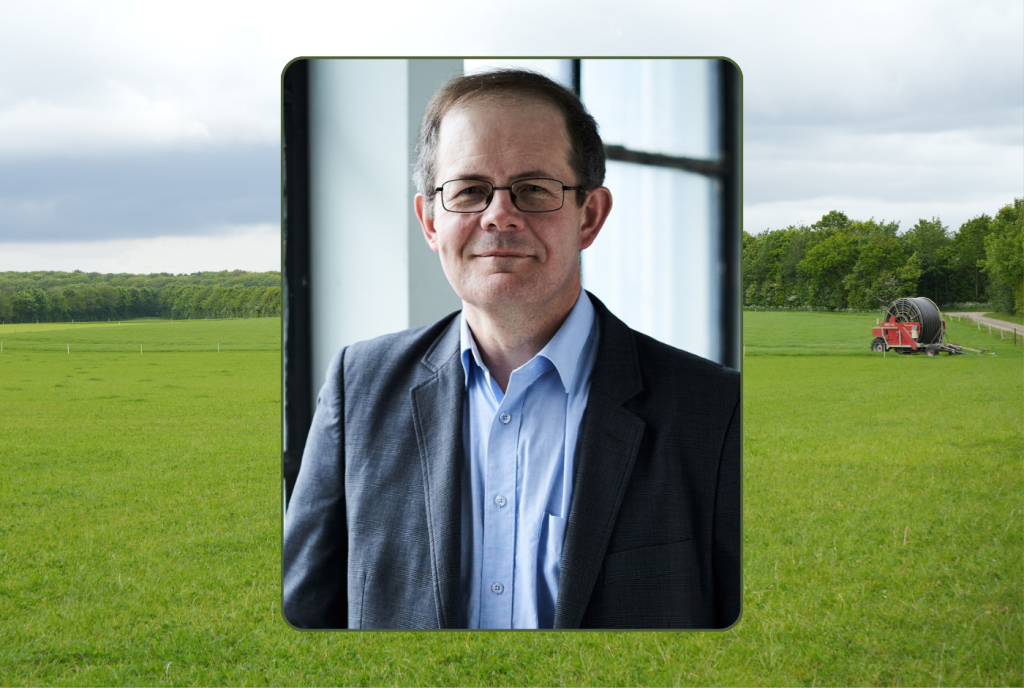
Claus Grøn Sørensen is a professor and researcher at Aarhus University, where he leads a research group focused on operations management and digital technologies in agriculture. In this interview, he shares insights into his academic background, his long-standing ties to farming, and his role in the Rural BioReFarmeries leading Work Package 1, which aims to optimise the biomass supply chain and improve the adoption of smart farming technologies.
Hi Claus! Let’s start from the beginning. What is your academic background?
I’m originally an agronomist by training, with a master’s degree in agronomy. Later on, I completed a PhD in operations and production management. That shift came naturally, as I wanted to bridge the biological side of agriculture with the more technical, engineering aspects.
What drew you to agronomy in the first place?
I’d say it definitely came from my upbringing — my parents had a farm, and I’m still very much involved in farming nowadays. So, there was never any doubt that I’d go into agriculture in some form. Some people in similar positions would often choose to become farmers or farm advisors, but I chose the agronomy path because I was also interested in the research and development side of farming and agriculture.
How did you get to your current position at Aarhus University?
After my studies, I started at an independent institution in Denmark focused on agricultural engineering, doing research and testing. In 2007, this institution was merged into Aarhus University, and this brought new elements like teaching and PhD supervision into my daily work.
Today, I lead the Operations Management research group at Aarhus, and our focus is on how technology can be used and optimised in agriculture. We are now part of the Department of Electrical and Computer Engineering, but our research and application area remains firmly rooted in agriculture. We’re especially involved in EU projects that explore the evaluation and optimisation of digital technologies in smart farming systems.
Aside from my role at Aarhus University, I’m also the current president of the International Commission of Agricultural and Biosystems Engineering (CIGR), a global organisation promoting biosystems engineering and cooperation between academia and industry.
When you mention agricultural technologies, what kinds of tools or systems are we talking about?
A good example is remote sensing, which involves using satellite or drone imagery to observe crops and soil, and then processing these data to identify things like weeds or crop development stages.
Another major area is data collection, as modern farm equipment generates a huge amount of data, but the challenge is turning it into useful decision-support tools for farmers. That’s what we work on in my research group: how to process and interpret the data to optimise everything, from harvesting schedules to soil preparation and machinery logistics.
So it would be fair to say that farming today is much more high-tech than people might think…
Absolutely. There’s a lot of technology already available, but a big challenge is adoption. Many farmers aren’t using these tools yet, and that’s something we’re actively researching. One key barrier is cost, of course, but another is understanding the actual benefits. Research plays a crucial role in clearly demonstrating these benefits, and we haven’t always done enough of that, but we’re trying to improve now.
Working with farmers is crucial, especially when investigating technology adoption. Conducting surveys and getting feedback directly from them helps us understand the barriers and motivations; this is also a key part of our work in the Rural BioReFarmeries project.
In terms of adopting these new technologies, what are the main concerns you hear from farmers?
Profitability is always a key concern. Margins are tight, and there’s very little room for error. Many farmers are interested in tools that can help them manage their business more efficiently. The wider concept of sustainability is also a growing concern, but it’s often easier to talk about concrete economic or environmental issues than more abstract concepts.
Another big issue is regulation — there are a lot of requirements farmers need to comply with. But here, again, digital tools can help by automatically documenting practices and ensuring compliance while also improving farm efficiency. The two go hand in hand.
Tell us more about your role in the Rural BioReFarmeries project.
I’m leading Work Package 1, which focuses on understanding and optimizing the entire biomass supply chain, from the farm to the final product. What attracted me to the project was this systems approach to green biorefineries, as previous studies have shown that the costs involved in handling biomass are often a key obstacle and can break the business case.
In RBRF, we have the chance to develop tools and methods to reduce these costs. This can also bring environmental benefits, like reducing CO₂ emissions, so it’s again two sides of the same coin: economic and environmental sustainability.
We now have access to innovative and robust technologies that weren’t available five or even ten years ago. AI, satellite data and optimisation tools are much more advanced and accessible today. That’s why now is the perfect time to be working on biomass handling challenges, because we can finally start implementing them at scale.
You’ll be working with several partners in this work package. How important is that collaborative approach?
Very important. It fits perfectly with the systems approach I mentioned. Traditional technologies, like machinery, could be introduced in isolation; but digital technologies like AI and data platforms affect the entire system. You need strong collaboration to manage that kind of complexity, and this project gives us that opportunity.
When the project ends in four years, what’s one thing you hope to have achieved?
I’d like to show that the whole process of handling and processing biomass can be made sustainable — economically, environmentally, and even socially.
We’ve had commercial-scale production sites in Denmark that had to shut down because the economics didn’t work. If we can demonstrate that new technologies can make it viable, that would be a big leap forward, and absolutely essential for scaling these systems.
Also, to give you a concrete figure, one of our goals is to improve the operational performance of the supply chain involved in green biorefineries by 10 to 40 percent, depending on the setup. That’s a specific target we’ll be working towards.
Stay up-to date with the Rural BioReFarmeries journey!
- Follow us on LinkedIn, X and BlueSky
- Watch our latest videos on YouTube
- Subscribe to the RBRF newsletter